The National Roadmap to Close the U.S. Water Gap
A sector-wide action plan to ensure every home in the United States has safe, reliable water and sanitation.

Our Vision
By 2040, every home in the U.S. will have access to clean, running water and a working toilet. Forever.
Join us in making this a reality.
The Issue
More than 2 million Americans lack safe running water or a working toilet at home. That number is growing.
Who are the 2 million+?
They are parents hauling water for their children. Elders living without a working toilet. Families choosing between paying for water and paying for food. They live across the nation: Tribal communities and Alaska Native villages, border colonias in Texas and New Mexico, Appalachian hollows, Black Belt communities across the rural South, manufactured home parks, unincorporated areas outside growing cities, and urban neighborhoods just beyond municipal service lines. What they share is not a single geography but a common condition: the infrastructure most people in America take for granted either never reached them or has failed entirely.
The crisis extends well beyond those without any access. An estimated forty million or more people in America have water or wastewater service that they cannot afford, cannot rely on, or that is already failing. This Roadmap addresses both realities while maintaining a clear center of gravity. The 2 million+ without any service anchor this work. Without that focus, attention drifts toward larger, more visible populations, while the communities that have waited longest get left behind again.
The Strategy
Why a Roadmap and why now?
This Roadmap was developed through 30+ interviews with sector leaders, listening sessions, and deliberation by a 18-member Steering Committee of TA providers, research institutions, Tribal organizations, utilities, NGOs, and philanthropy. The Roadmap is a tool for collective action, not a single organization's plan.
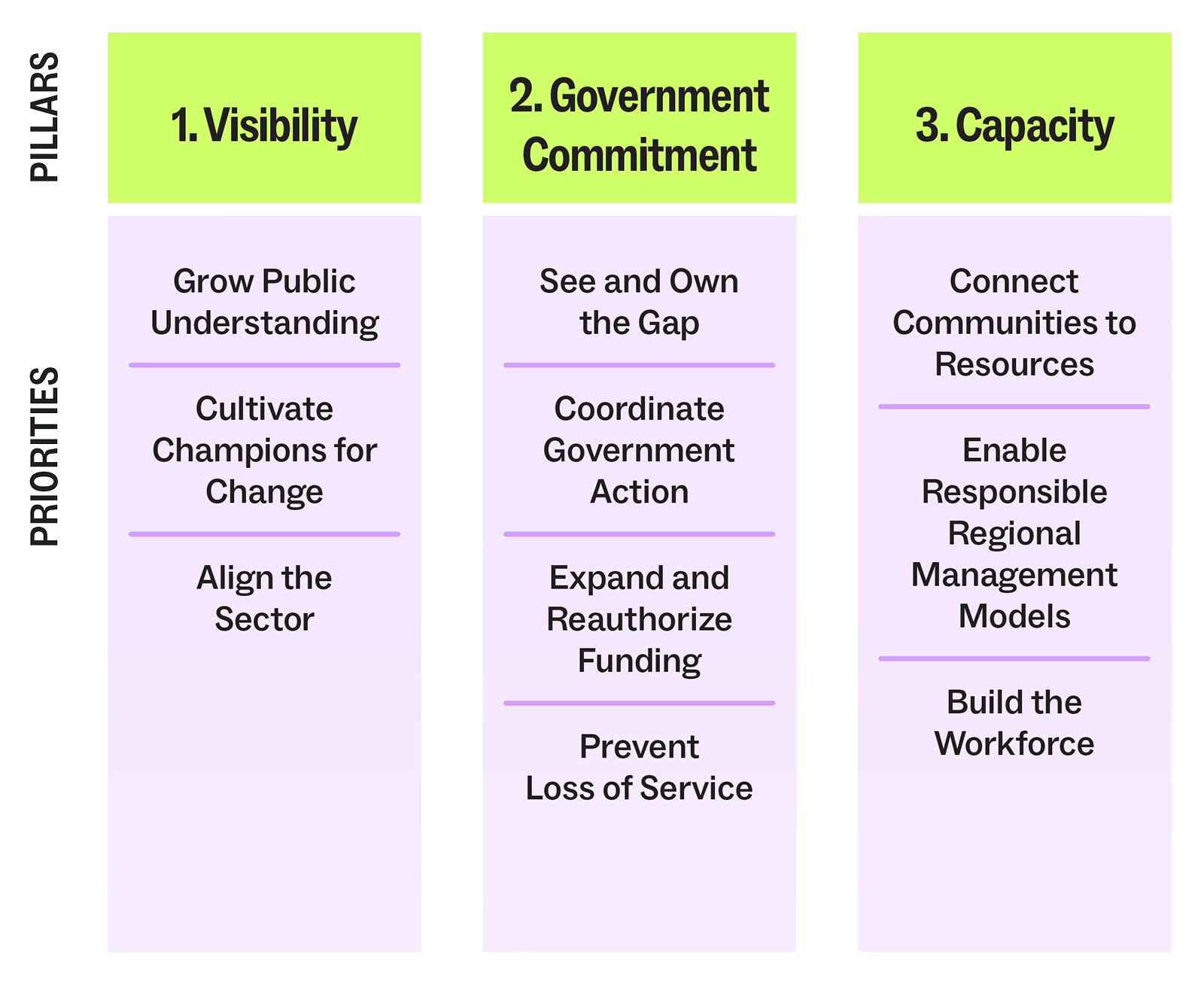
Three pillars. Ten priorities.
The pillars respond directly to the conditions that have allowed the gap to persist: the problem is invisible, government investment has never matched the need, and support systems don't reach the communities that need them most.
One Implementation Plan
The National Roadmap is a long-term strategy. This Implementation Plan outlines the first phase of action: the Startup Phase (Years 1–3).
While the Roadmap defines the broader vision and strategic direction, this document focuses on the immediate work needed to build momentum, strengthen coordination, and lay the foundation for long-term progress. The priority actions below were selected because they protect what is already working, address urgent gaps, and create the conditions needed for larger-scale implementation over time.
This Implementation Plan is intentionally practical and lean. It does not repeat the Roadmap’s full strategy or evidence base; those live within the Roadmap itself. Instead, it is designed as a working document for the people closest to implementation – Vessel staff, working groups, Steering Committee members, and sector partners actively advancing this work.
The plan is meant to be used, revisited, and refined as implementation evolves. Priorities and activities will continue to adapt as the sector grows, new partnerships emerge, conditions shift, and lessons are learned.
Startup Phase Priority Actions (years 1–3):
Convene the sector
Make the gap visible to the people who can close it.
Bring decision-makers and communities into the same room.
Defend the funding that already reaches communities, and push to expand it.
Build momentum in focus states.
Build a sector resource library.
Connect communities to the resources and expertise they need.
Support the workforce that keeps systems running.
The Invitation
The solutions are known but the truth is clear: no single organization will close the water access gap alone.
Doing so will require coordinated effort across the sector. Community leaders, Tribal nations, utilities, nonprofits, researchers, philanthropy, private companies, and policymakers each have a role to play, and progress depends on how well those roles come together. It will require shared ownership of the strategy, sustained alignment, and a commitment to track progress over time. Section 6, Call to Action, outlines specific ways to engage.
The National Roadmap to Close the U.S. Water Access Gap is designed to support that work. It is a shared framework for action, helping organizations understand where they fit and how their efforts connect to a broader national strategy. Section 6: Call to Action, outlines specific ways to engage.
The path forward is clear. The priorities are defined. What remains is the decision to act.
We invite you to take part in that work.
For some, that will mean publicly endorsing the Roadmap. For others, it will mean continuing to work alongside partners to advance the priorities outlined here. Each contribution strengthens the collective effort.
The Endorsing Organizations